

Northern Bayberry and its Waxy Berries
- Jennifer Anderson

- Jan 11
- 4 min read
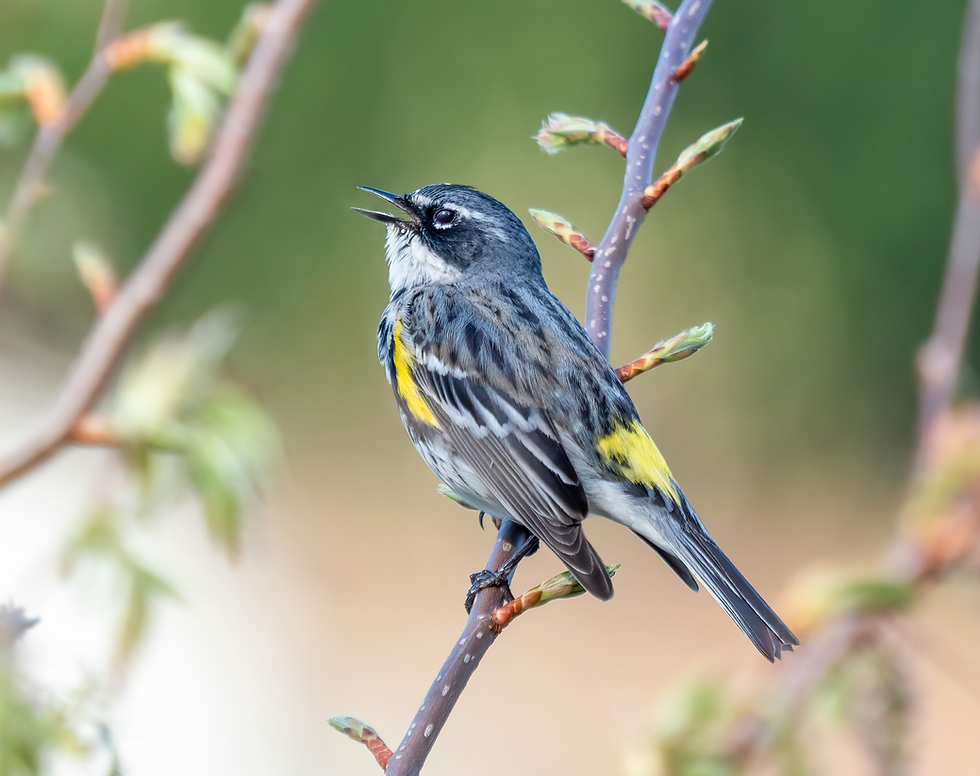

Throughout the cold winter in New England, the Yellow-rumped Warblers flit about, feasting on the waxy berries of Northern Bayberry.
These particular warblers, “Butterbutts,” have evolved special bile sacs that allow them to digest the proteins and fats within the berries’ waxy coatings.
Otherwise, they would be down south with all the other warblers feeding on insects, explains Laura Carberry, of the Audubon Society of Rhode Island.
They also eat Eastern Redcedar berries but prefer Bayberry and Poison Ivy, “suggesting there is more energy and protein in those two species,” she says.

A Coastal Denizen
Northern Bayberry (Morella pensylvanica) grows naturally along the coast, enjoying the sand, salt and sun and using its suckering roots to stabilize the dunes. (A cousin, wax myrtle (Morella cerifera) grows from New Jersey south.)
Increasingly, Northern Bayberry is being used in home landscapes for its deer resistance, mostly evergreen foliage, dense branching and unusual berries.
The leathery leaves and berries also emit a woodsy, spicy scent when crushed–“a wonderful odor of camphor and oregano,” describes William Cullina, in Native Trees, Shrubs, & Vines.

Nitrogen Fixer
The flowers on Bayberry are known as catkins, which are long and slim with no petals (think of Pussy Willow). Plants have either male or female catkins, and on Bayberry at least one male – along with a good wind – is needed to fertilize the females.
Northern Bayberry grows in rain gardens, dry soil and high wind. It also is a “nitrogen fixer,” which means it’s able to take nitrogen from the air and transfer it to the soil, providing nutrients for itself and its neighbors.
In total, Bayberry adds 30 to 70 pounds of nitrogen per year to the soil, which USDA calls “a substantial nitrogen addition.”
This ability to fix nitrogen is among reasons Bayberry will grow in poor soils – or even no soils – such as along the edges of railroad tracks, although it tops out at only about 3 to 4 feet.
In better soils it will grow 7 or even 15 feet with a 5- to 10-foot spread. All Northern Bayberry asks is for full to mostly full sun.
Lore
Native Americans boiled the leaves of Northern Bayberry to treat fevers, and settlers boiled the wax to treat dysentery.
In the early 1800s, New Englanders believed it to be a cure-all for everything from colds to bruises and insect bites.
We now know the wax on Bayberry berries is toxic to people and best left for the songbirds, turkeys, pheasants, squirrels, opossums and foxes.
The leaves, however, are great for flavoring soups and make a nice substitute for Bay Leaf in cooking.
Try pairing Northern Bayberry with Inkberry, New Jersey Tea and Winterberry.
Also try Switchgrass, Butterfly Milkweed, Mountain Mint and Prairie Dropseed for a full and diverse native plant garden.

Caterpillars of the Columbia Silkmoth, which eat the Bayberry leaves, will thank you – as will the Northern Harrier, which is rare in Massachusetts but has been seen roosting in dense stands of Bayberry along the South Coast.
Because the bayberry fruits typically grow above snow accumulations, other happy campers might include ruffed grouse, turkey, pheasants, woodpeckers and swallows.
Fun fact: 😃 “One hundred percent of the 65 specimens of tree swallows dissected during a vegetation management study at John F. Kennedy International Airport contained bayberry fruit.” – USDA
DIY -- Bayberry Candles 🕯️
The waxy coatings were suitable at one time for making candles. These days it’s more efficient to use soy and beeswax. But if you want to give it a try, here are the directions, courtesy of Cullina (Native Trees, Shrubs, & Vines)
Gather 4 pounds of berries (yes, that’s a lot and should yield 1 pound of wax)
Drop the berries in boiling water
Stir and smash the fruits until the wax rises to the surface
Skim off the wax and put in cool water to congeal
Re-melt the wax in boiling water and pour into candle molds
*Don’t forget to add the wicks before the wax hardens!
About the author

Jennifer Anderson owns Tree Talk Natives, a native tree and plant nursery in Rochester, Mass. A former news reporter, she loves to write and talk about native plants. Jennifer also gives garden consultations and presentations on native plants. She can be reached at jennifer@treetalknatives.com.
Sources:
Bayberry – The Scent of New England. Uconnladybug’s Blog. The University of Connecticut Home and Garden Education Center (Dec. 27, 2019).
Carberry, L. Director of Properties, Audubon Society of Rhode Island. E-mail exchange, January 8, 2026.
Carberry, L. Let's Go Birding | From Insects to Berries – Yellow-rumped Warblers Adapt for Winter Audubon Society of Rhode Island (Dec. 2, 2022).
Clausen, R.R. and Gregory D. Tepper. Deer-Resistant Native Plants for the Northeast. Timber Press, Oregon (2021). Pp: 200-202.
Cullina, W. Native Trees, Shrubs, & Vines. Houghton Mifflin, Boston (2002). Pp: 173-175.
Dirr, M. The Manual of Woody Landscape Plants. Stipes Publishing Company, Champaign, Ill. (1990) P. 560-561.
Hauser, A.S. Morella pensylvanica. USDA Fire Effects Information System (2006).
Lorimer, U. The Northeast Native Plant Primer. Timber Press, Oregon (2022). P. 96.
Morella (Myrica) pensylvanica – Bayberry, Candleberry. School of Integrated Plant Science, Cornell University. YouTube video.
Myrica pensylvanica. Missouri Botanical Garden Plant Finder
Steele, J. Yellow-rumped Warbler. Southern Wisconsin Bird Alliance (April 11, 2025).
Wilson, N. Trees With Catkins. GardenersWorld.com. BBC Gardeners’ World Magazine (Nov. 27, 2023).


Excellent article! I learned so much.