

Blueberries, High and Low
- Jennifer Anderson

- Jan 3
- 3 min read
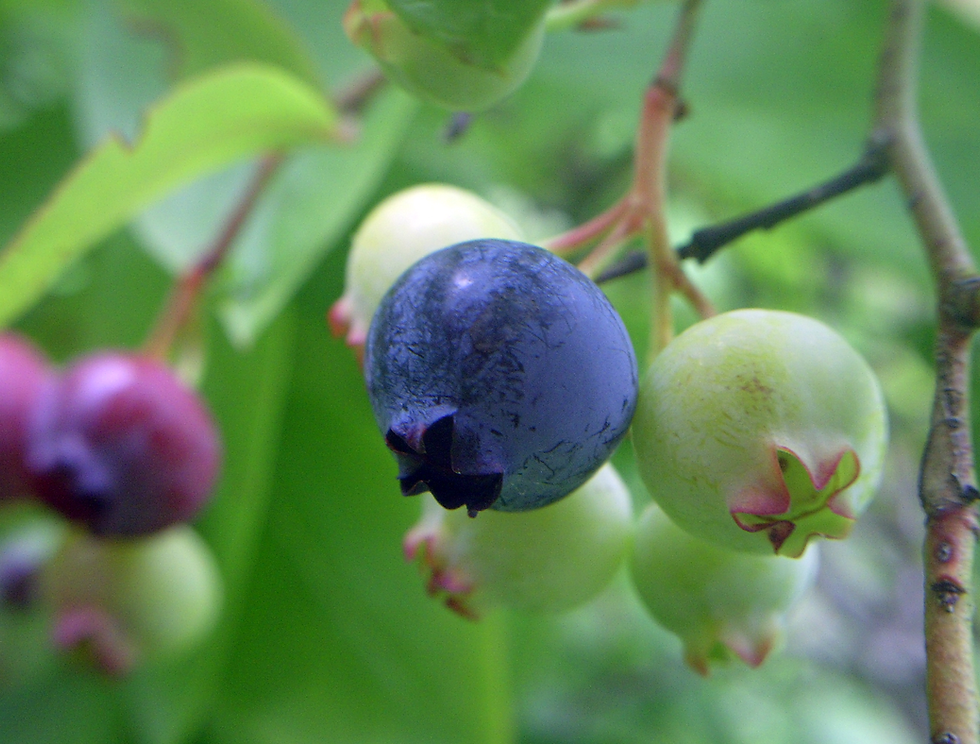
When I think of blueberries, I reminisce to my childhood in New Hampshire, rowing out to the island on Spofford Lake and collecting the sweet, plump fruits.
Thus New Year’s Resolution No. 1 for 2026: plant more blueberries! 🫐😃
There are two natives in New England: Highbush and Lowbush.
First, the similarities.
Both:
Have urn-shaped, pinkish-white spring flowers that, if pollinated, morph into tasty berries in time for summer.
Can cross pollinate with each other.
Are host plants for the Brown Elfin Butterfly:

Support specialized bees, ruffed grouse, black bears, deer, rabbits and a host of songbirds: Robins, Bluebirds, Towhees, Catbirds, Mockingbirds, Cardinals.
Like acidic soil and full sun, although light shade is tolerated.
Have reddish spring foliage that turns blue-green in summer before morphing into glorious purples, reds and oranges in the fall.
Produce healthy berries, high in iron and antioxidants.

Diving in:
Highbush Blueberry, Vaccinium corymbosum, is a biggie, growing 3 to 10, or even 12, feet tall and wide.
A slow grower, it features a dense, round shape and twisted branching.
It is naturally attracted to bogs, swamps and openings in high-elevation forests, where it can get plenty of sun. If you’re on the coast, no worries! Highbush adapts extremely well to sandy soils.
Its blue-black fruits are ¼-inch and edible right off the bush.
Immediately after planting, and for the next year, pop off all the flowers so the bush can concentrate on root growth. After that, if you need to prune, do so in winter.

Try highbush with other plants that like acidic soils, such as hollies and rhododendrons.
Fun fact: 😃 Vaccinium corymbosum refers to the way the flowers and berries grow in corymbs, where the lower stalks grow longer than the upper stalks so all the flowers are even, forming a down-drooping, flat-bottomed cluster.

Lowbush Blueberry, Vaccinium angustifolium, the fruit of Maine, is the shorty, growing only 2 feet tall and 3 feet wide. It makes an excellent low hedge or ground cover and colonizes by sending out horizontal stems underground.
Unlike its big cousin, Lowbush likes dry soils, and its fruit is smaller and may taste a bit sweeter. And while one Highbush may produce fruit, Lowberry needs a partner for fruit.
“Attractive and tough” -- Wild Seed Project

Lowbush does well on sandy, gravely soils as long as they are well drained. Try Lowbush in rock gardens, near stone walls and sidewalks, and abutting patios.
Lowbush Blueberry pairs nicely with Black-eyed Susans, Purple Lovegrass, Wild Strawberries, Yarrow and Wavy Hairgrass, although this last one prefers a little shade.
Fun fact: Lowbush’s flowers and fruits grow in racemes, in which the twigs are the same length up and down the stems.
About the author

Jennifer Anderson owns Tree Talk Natives, a native tree and plant nursery in Rochester, Mass. A former news reporter, she loves to write and talk about native plants. Jennifer also gives garden consultations and presentations on native plants. She can be reached at jennifer@treetalknatives.com.
Sources:
Cullina, W. Native Trees, Shrubs, & Vines. Houghton Mifflin Company, Boston. (2002) P. 250
Dirr, M. Manual of Woody Landscape Plants, Fourth Edt. Stipes Publishing Company, Champaign, Illinois (1990) Pp: 883; 885.
Fialkoff, A. and Heather McCargo. Native Ground Covers for Northeast Landscapes. Wild Seed Project, Maine. (2022). P. 14, 36
Loriimer, U. The Northeast Native Plant Primer. Timber Press, Portland, Oregon. (2022) P. 108.
Vaccinium angustifolium, North Carolina Extension Gardener Plant Toolbox.
Vaccinium corymbosum, North Carolina Extension Gardener Plant Toolbox.


Comments